
Not everyone works at a desk or starts their day online. 44 Writer and Senior Project Manager Bryan Jones looks at why print continues to cut through with so‑called ‘hard‑to‑reach’ audiences.
For years now, digital has been the default answer to almost every communications challenge. Faster. Cheaper. Easier to update. And on paper (no pun intended), that all makes perfect sense.
But when it comes to so‑called ‘hard‑to‑reach’ audiences, digital often isn’t the silver bullet we like to think it is.
Busy, not disengaged
The clue is in the phrase.
Hard to reach usually doesn’t mean people are disengaged or uninterested. It means they’re busy. Working shifts. On their feet. Away from desks, inboxes and logins. They might be working underground, high up on scaffolding or in a dumper truck. Sometimes they’re simply completely focused on getting the job done safely and well.
In those environments, access matters more than innovation.
Not everyone starts their day by opening an intranet homepage. Not everyone has the time – or inclination – to scroll through screens between tasks.
And not everyone is allowed to carry a device while they’re working.
Pretending otherwise doesn’t make communication more effective; it just makes it easier to ignore.
That’s where print comes into its own.
Why print still cuts through
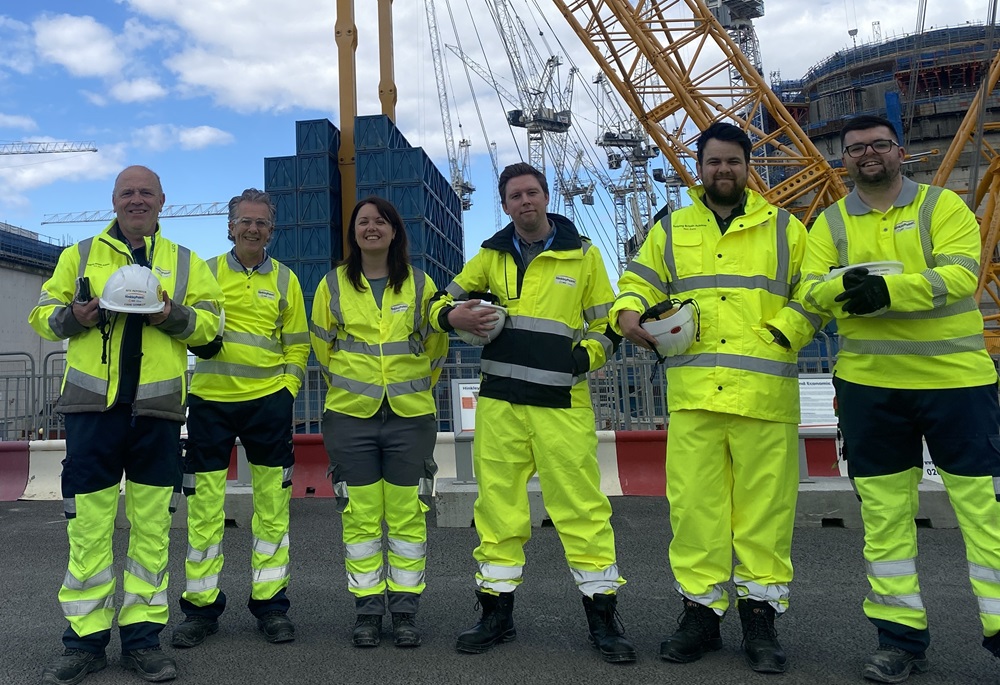
We’ve just celebrated the publication of the 100th edition of The Point, the newspaper for people working at Hinkley Point C (pictured above) on the Somerset coast, near Bridgwater.
It’s the largest construction project in Europe, with around 15,000 people working across the site.
They know a printed newspaper (or a poster or a table-talker) doesn’t need a password.
It doesn’t need a mobile signal or a spare moment in front of a screen. It can be seen in a canteen, glanced at during a break, folded into a pocket or passed from one person to another. It fits naturally into someone’s working life, rather than asking them to adapt to it.
Print also does something digital often struggles with – it signals importance.
When something arrives in print, it feels deliberate. Considered. Worth paying attention to. It slows people down just enough to take things in properly – especially when the story is well told and recognises the people reading it.
Putting people at the heart
Print works best when it’s used to tell human stories. When it reflects real experiences, real effort and real progress. When people can see themselves – or their colleagues – in the words and pictures. That sense of recognition is powerful, particularly on large, complex projects where it’s easy to feel like a small cog in a very big machine.
This isn’t an argument against digital. That clearly has an important role to play. But reaching people isn’t about choosing the newest channel or the cleverest tool. It’s about understanding how people actually work, where they are, and what will genuinely land with them.
Sometimes, the most effective solution isn’t the most modern one. It’s the one that’s been quietly doing the job all along.
Find out more
If you want to see what this looks like in practice, take a look at our case studies on reaching frontline employees with print.